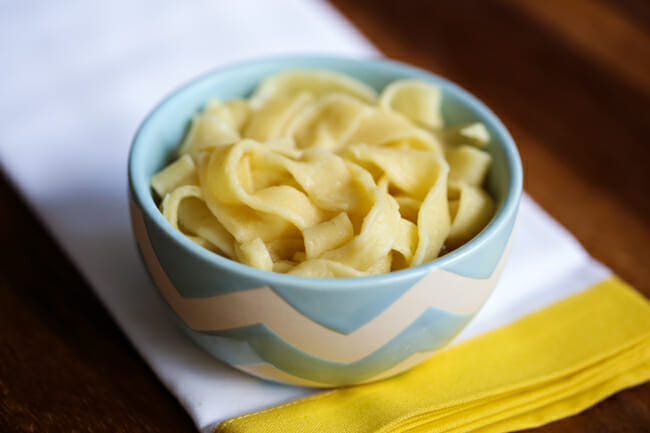
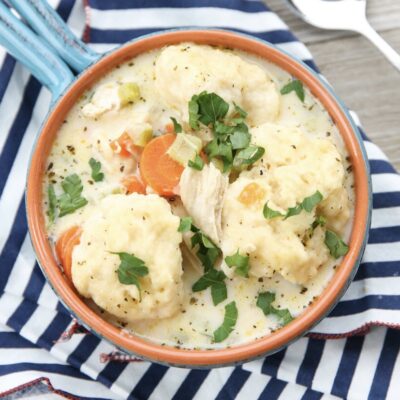
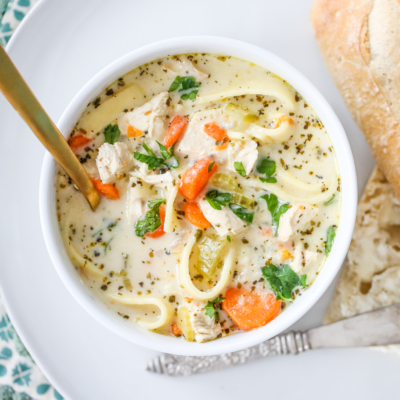
When it comes to carbs, I can take or leave candy and most bread, but noodles are my ultimate comfort food. Chicken noodle soup is my favorite sick food ever. Ever ever. And really, I’m in it for the noodles just as much as anything else. My go-to recipe is this Chicken and Dumplings recipe from the darkest corners of the OBB archives. Up until about a year ago, I always used packaged noodles, but my ability to find my favorite noodles is fairly hit and miss, so I decided to learn how to make homemade egg noodles.
I present you with my short Pro-Con list of homemade noodles:
Cons:
- You have to, you know, make them.
- They’re not always as “pretty” and uniform as store-bought pasta.
- They make a bigger mess.
Pros:
- If you cook them before drying them, they don’t absorb liquid like regular noodles, so if you leave them in your soup, they’re less likely to soak up all the broth.
- It’s fun and highly satisfying to make them.
- They are surprisingly easy.
- They’re so delicious. Much like homemade tortillas, once you start making your own noodles, it’s hard to go back to not-homemade noodles.
Ingredients Needed
This is just a preview of ingredients and method, keep scrolling for full printable recipe.
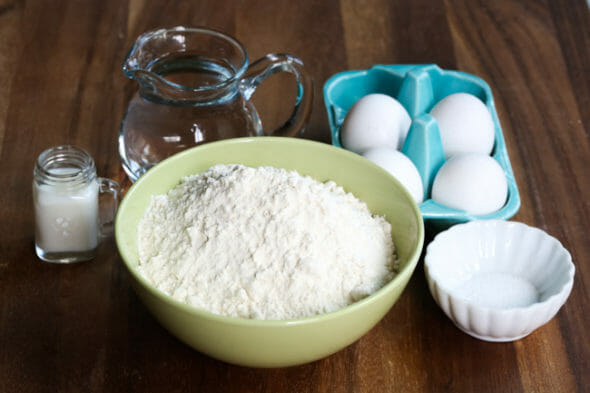
- All-purpose flour – Flour provides the gluten that gives the noodles their chew and elasticity.
- Kosher salt – Tightens the gluten and deepens flavor.
- Whole eggs and egg yolks – Provide protein and fat that result in strong, rich noodles.
- Milk – A little dash of milk helps keep the noodles tender.
- Cold water – Water brings the dough together. Using cold water makes the dough easier to work with by keeping it nice and firm.
How to Make Homemade Egg Noodles
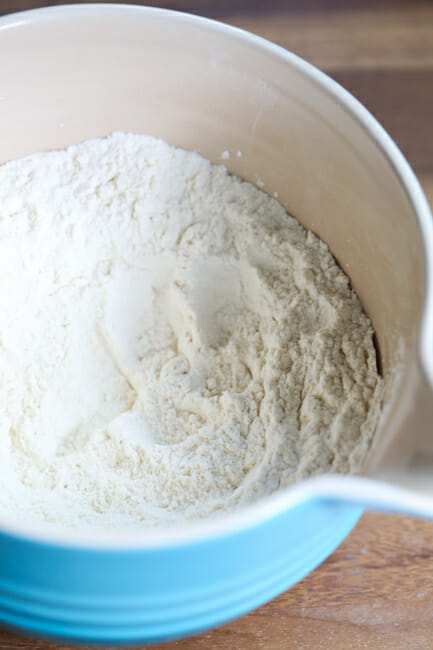
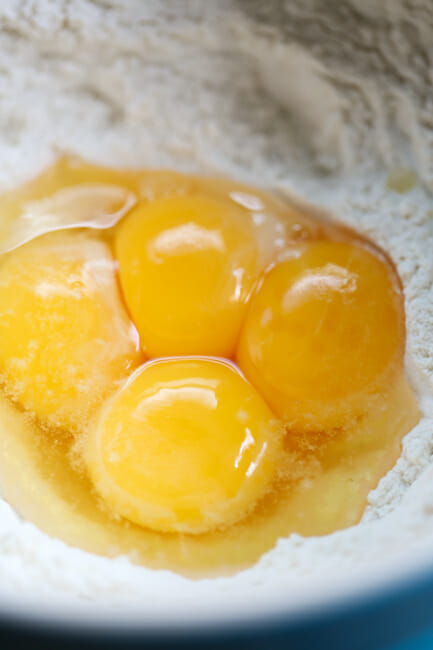
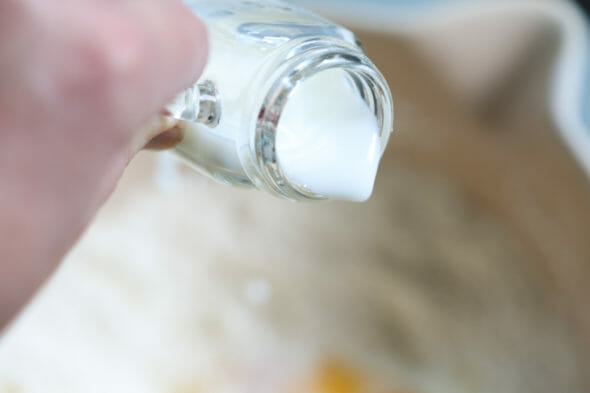
- Star by whisking the flour and salt together. Make a little well in the center and add the egg yolks, eggs, and a drizzle of milk.
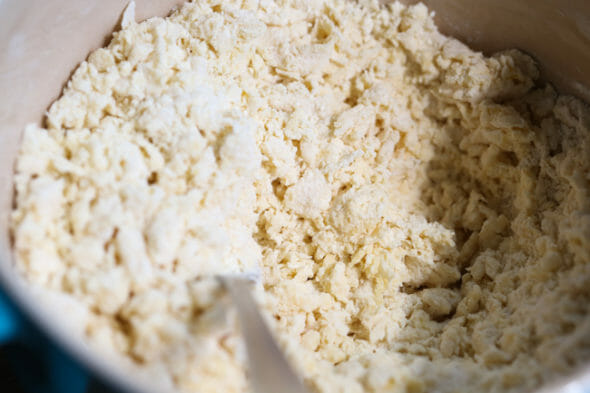
- Using a fork, start lightly blending the mixture until it is evenly moistened and looks pebbly (kind of like scrambled eggs).
- Then you drizzle in some cold water a little at a time until it starts coming together into a ball (you’ll have to start using your hands here). Keep mixing until all the flour has been incorporated but it’s not overly sticky. It’s hard to add too much flour here–the noodle dough will take what it needs and leave the rest.
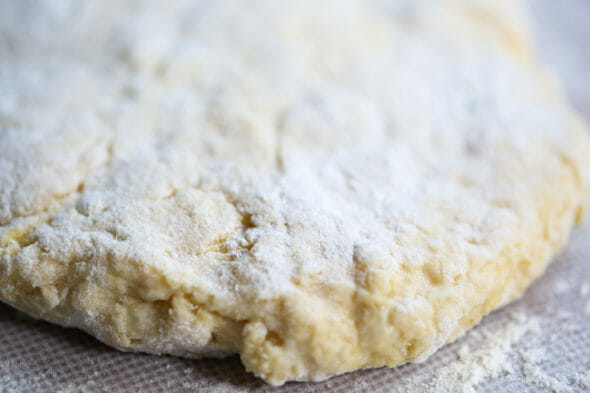
- Sprinkle a work surface with a little flour. Roll half of the dough out onto the work surface, flouring everything along the way (your hands, rolling pin, additional flour for the work surface, etc.). Flour is your friend here–at this point, the dough won’t take in any more than it needs, but it will keep your noodles from sticking to anything and everything. Any excess will just fall off in the cooking or drying process.
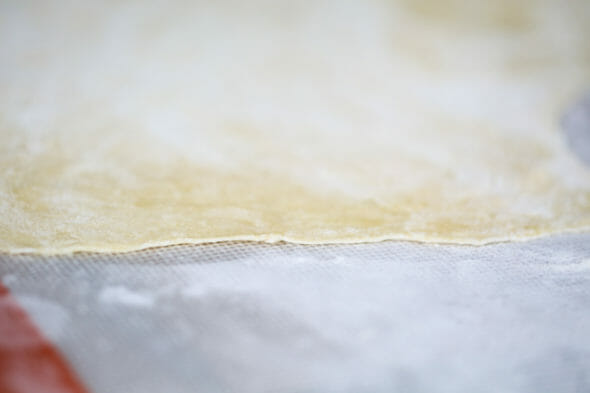
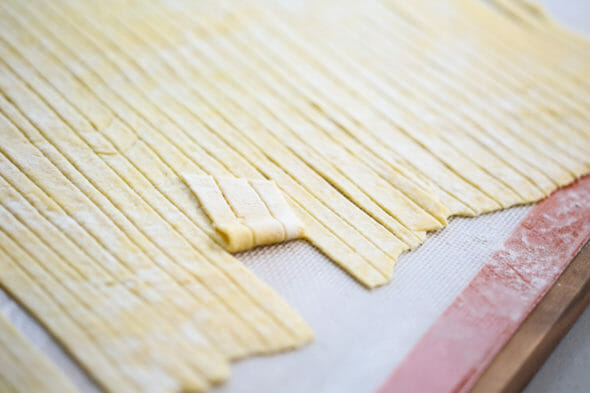
- Roll the dough until it is paper thin, about 1/16″. Using a pizza wheel, cut the dough into strips (anywhere from skinny to very wide). You can also cut the noodles to the desired length, especially if you’re cooking them right away.
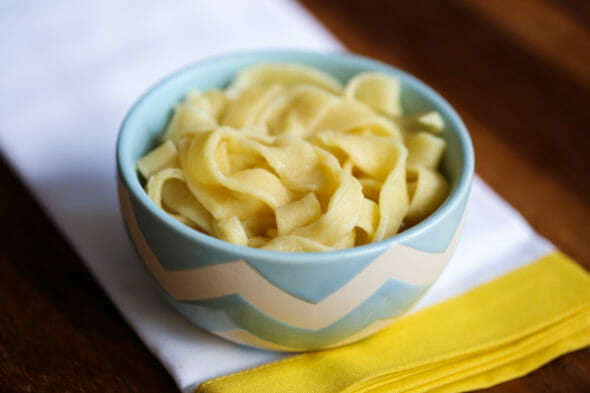
- You can either cook these immediately in boiling liquid (about 2-3 minutes or until they pop up to the top) or drape them on a clean dowel or pasta drying rack and allow them to dry completely. When dry, break into pieces (or don’t if you don’t want to) and then store them in an airtight bag.
- Cook from dry for about 3-5 minutes or until tender. Enjoy!
Storing and Other Tips
- Refrigerator: Store uncooked noodles, lightly dusted with flour to prevent sticking, in an airtight container for up to 2 days.
- Freezer: Freeze noodles in nests or flat layers for up to 2-3 months. Cook straight from frozen.
- Cooked noodles: Store in an airtight container in the refrigerator and enjoy within 3-4 days for best results.
- Dried noodles: Store completely dried noodles in an airtight container at room temperature for 2-4 weeks, or in the freezer for 2-3 months. Note: make sure they’re 100% dry before storing to prevent mold. There should be no bend or softness left in them before storing. If in doubt, store in the freezer!
Frequently Asked Questions
Nope. They can be cooked immediately!
Yes, if you have one, that’s the best way to get uniform noodles.
Gluten-free flour won’t be a 1:1 swap here. While it’s totally possible to make gluten-free noodles at home, I would recommend finding a recipe that’s specifically written to be gluten-free.
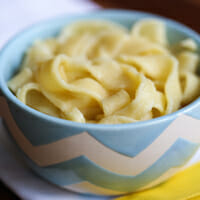
How to Make Homemade Egg Noodles
Ingredients
- 2 cups all-purpose flour
- 1 teaspoon kosher salt
- 3 egg yolks
- 1 whole egg
- 2 tablespoons milk
- ¼-½ cup cold water
Instructions
- Whisk together the flour and salt. Make a well in the center and add the egg yolks, eggs, and milk. Using a fork, start lightly blending the mixture until it is evenly moistened and looks pebbly (kind of like scrambled eggs.)
- Drizzle water, about 1 tablespoon at a time, over the mixture and mix until it starts to come together in a ball (you’ll have to use your hands at some point). Keep mixing until all the flour has been incorporated but it’s not overly sticky.
- Sprinkle about ¼ cup of flour on a clean work surface, having more flour handy if necessary. Roll half of the dough out onto the work surface, flouring everything along the way (your hands, rolling pin, additional flour for the work surface, etc.). Roll the dough until it is paper thin, about 1/16″ (about 1.5mm).
- Using a pizza wheel, cut the dough into strips (anywhere from skinny to very wide). You can also cut the noodles to the desired length, especially if you’re cooking them right away.
- You can either cook these immediately in boiling liquid (about 2-3 minutes or until they pop up to the top) or drape them on a clean dowel or pasta drying rack and allow them to dry completely. When dry, break into pieces (or don’t if you don’t want to) and then store them in an airtight bag. Cook from dry for about 3-5 minutes or until tender.
Notes
Storage
- Refrigerator: Store uncooked noodles, lightly dusted with flour to prevent sticking, in an airtight container for up to 2 days.
- Freezer: Freeze noodles in nests or flat layers for up to 2-3 months. Cook straight from frozen.
- Cooked noodles: Store in an airtight container in the refrigerator and enjoy within 3-4 days for best results.
- Dried noodles: Store completely dried noodles in an airtight container at room temperature for 2-4 weeks, or in the freezer for 2-3 months. Note: make sure they’re 100% dry before storing to prevent mold. There should be no bend or softness left in them before storing. If in doubt, store in the freezer!
Nutrition








Questions & Reviews
It is the WORST–like way worse than any of my c-sections. It took me forever to recover!!
I totally forgot!!! Celebration, haha!
I’m am old welder and I just jumped in here to say I love your noodles!! Thanks so much for being you! Michael
Thank you, Michael! 🙂
Ok I’m trusting you here! I’ve been wanting to try making my own egg noodles and this looks easy enough! Thank you for alleviating my noodle making fears!
Yes, I’ve had some epic noodle fails in the past, too. I was scared, but I’m not scared anymore, haha.
I tried making homemade egg noodles a couple years ago, and they turned out horrible! They were like big fat worms, and they turned GREEN when I cooked them. It was seriously scary. Thank you so much for this! I’m sure these ones will turn out great!
Green??? No! That’s crazy! I wonder what happened? Hahaha! I’m not laughing at you, promise. Just with you. 🙂
I love love love homemade noodles! My favorite was chicken & noodles as a kid, so yummy and comforting. I’m so glad you posted this, as the recipe I use calls for canned milk, part of a can anyway. So, I’m glad I now have a recipe that has stuff that I always have on hand.
Awesome!! Let us know how they turn out! 🙂
I love homemade noodles.
🙂
Right now our house is on the market and we are getting ready to move and I teach early morning seminary and we’re getting ready for my son’s Eagle court of honor and my daughter’s baptism and company coming for the big events, but as soon as my life calms down I totally want to try making these. I’ve been doing a lot of 1 egg plus 1 egg white omelets and I’ve been throwing away the extra yolks, but this will be a perfect use for them.
Have you ever made them with all or part whole wheat flour? Do you know if it requires any changes to the recipe? Oh, and how many noodles does it make? Is this equivalent to a 1 pound bag?
I’ve never tried it with wheat noodles, but I’m almost positive you can even use all wheat flour. Once you get the hang of it, it’s a very forgiving recipe, so just play around with it and see what works! 🙂 And I’d say an entire recipe is about equivalent to a 1-pound bag–I usually use half of the noodles right away and dry the other half for later.
Thanks! I love it that you guys always answer our questions.
Another way to cut the noodles is to roll the dough up and then slice (as if you are making cinnamon rolls, but way thinner slices).
Awesome tip!! Thank you! 🙂
Perfect! I was going to suggest the same thing but couldn’t think how to describe it. Roll the noodles and slice like cinnamon rolls. Way to figure it out of my head for me!
But you blew me away with these noodles, don’t mind the ugliness at all, I’m loving how you said they won’t as easily suck up all the juices, how can that be? That is ALWAYS my struggle with chicken noodle soup, store bought noodles get HUUUUUUUUGE and ruin the soup. Thanks for this inspiration!!
Right?? It’s always more like chicken noodle casserole the next night. That no one wants to eat. 🙂
These look so good! Maybe I’ll finally try making my own pasta. What is that material you are rolling on?
It’s a Roul’pat–basically a silicone mat for rolling. 🙂
http://www.amazon.com/Non-Stick-Silicone-Countertop-16-5-Inch-24-5-Inch/dp/B00008T961/ref=sr_1_1?ie=UTF8&qid=1412174822&sr=8-1&keywords=roulpat